Hemant Seth's Blog Posts
Hemant is a Principal Product Manager at Splunk, leading the Kubernetes Monitoring offering within Splunk Observability Cloud. Prior to this role, he focused on Splunk Observability Platform administration, including identity management and license usage. Hemant brings over a decade of experience in the observability domain and holds a Master’s degree in Electrical Engineering with a specialization in Telecommunications.
Display Mode
Paginated
Filter
Author
Author URL
Limit
6

Using Splunk to Secure Your Productivity and Team Collaboration Environment
See how Splunk helps teams work and collaborate securely while using Google Chrome and Google Workspace.
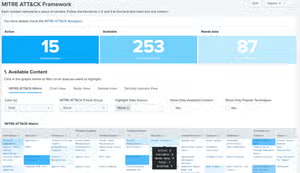
Do More with Splunk Security Essentials 3.7.0
Check out some highlights of the new features available in Splunk Security Essentials 3.7.0.

Splunk Named a Leader in the 2022 IDC MarketScape for SIEM
See why Splunk earned a spot in the 'Leaders' category in the 2022 IDC MarketScape for worldwide SIEM software.
Operational resilience, as seen by our French customers
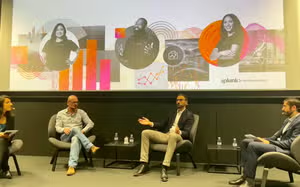
On October 18th, .conf Go was held in Paris. It was an opportunity to finally meet in-person and discuss the latest developments in cybersecurity and observability. Operational resilience was high on the agenda. We were able to discuss it with two of Splunk’s customers: David Charpagne, Global SOC Manager at Carrefour, and Youssef Kilany, Director of Architecture and Production at Net-entreprises (GIP-MDS).

Security 2023: Supply Chain Resilience, Talent and More
Splunk CISO Jason Lee takes a deeper dive into our 2023 Security Predictions report and explores why the linking of resilience and security is here to stay.

Visualising a Space of JA3 Signatures With Splunk
One common misconception about machine learning methodologies is that they can completely remove the need for humans to understand the data they are working with. In reality, it can often place a greater burden on an analyst or engineer to ensure that their data meets the requirements, cleanliness and standardization assumed by the methodologies used. However, when the complexity of the data becomes significant, how is a human supposed to keep up? One methodology is to use ML to find ways to keep a human in the loop!